Server-Side Row Model (SSRM)
When the data lives on the server - millions of rows in a database - the grid
should hold only the page on screen and push sorting, filtering, and paging to
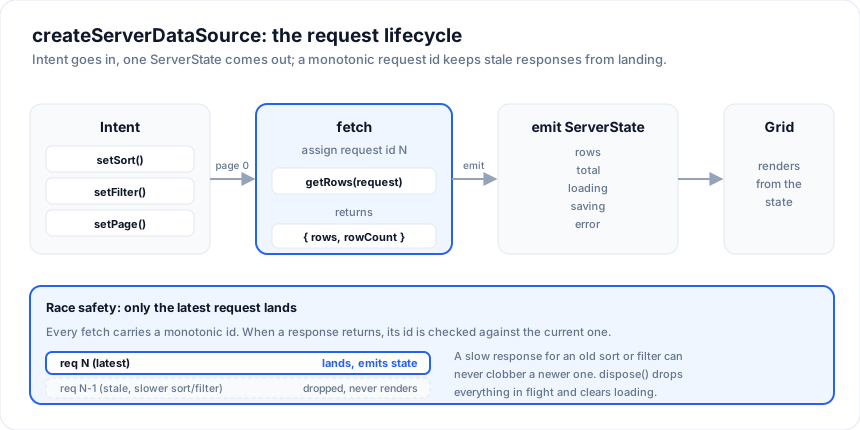
the backend. SvGrid packages this as one datasource contract: you implement
a single async getRows, and createServerDataSource owns the request
lifecycle (paging, sort, filter, race-safety, writes).
Open the live example: Server-Side Row Model (SSRM) (Server-Side Data)
Scope. This is a page-based server model: one page is in memory at a time and each fetch loads exactly that page. It is not infinite block-scroll with a background block cache, and it does not lazily load group children on the server. For those, see what this does not do.
Quick start
import { createServerDataSource, type ServerDataSource } from '@svgrid/grid'

const source: ServerDataSource<Row> = {
  async getRows({ startRow, endRow, sortModel, filterModel }) {
    const res = await fetch('/api/rows', {
      method: 'POST',
      body: JSON.stringify({ startRow, endRow, sortModel, filterModel }),
    })
    const { rows, total } = await res.json()
    return { rows, rowCount: total } // rowCount = total AFTER filtering
  },
}

let view = $state(/* ServerState */)
const ctl = createServerDataSource(source, { pageSize: 50, onChange: (s) => (view = s) })
ctl.refresh()
The request your server receives
Every fetch calls getRows(request) with this exact shape:
type ServerRequest = {
  startRow: number   // first row wanted, inclusive  (= pageIndex * pageSize)
  endRow: number     // one past the last row wanted, exclusive
  pageIndex: number
  pageSize: number
  sortModel: ServerSortModel
  filterModel: ServerFilterModel
}
startRow / endRow are the page bounds (they map to OFFSET / LIMIT),
not block-cache bounds. Return { rows, rowCount } where rowCount is the total
count after filtering - the pager needs it to compute the last page.
The sort model
type ServerSortModel = Array<{ id: string; desc: boolean }>
Multi-column, in priority order. So this:
[{ "id": "lastName", "desc": false }, { "id": "age", "desc": true }]
maps to ORDER BY last_name ASC, age DESC.
The filter model
type ServerFilterModel = {
  global?: string                 // the quick-filter search box
  columns?: Record<string, {      // keyed by column id
    operator: string              // equals | contains | startsWith | greaterThan | lessThan | between | isBlank
    value: string
    valueTo?: string              // second bound, for `between`
    selectedValues?: string[]     // set-filter (facet checklist) selection
  }>
}
A populated model looks like:
{
  "global": "berlin",
  "columns": {
    "status":  { "operator": "equals",  "value": "active" },
    "age":     { "operator": "between", "value": "18", "valueTo": "65" },
    "country": { "operator": "contains", "value": "", "selectedValues": ["DE", "FR"] }
  }
}
Translating the model to SQL
Map each column filter's operator to a predicate:
operator |
SQL |
|---|---|
equals |
col = $value |
contains |
`col ILIKE '%' |
startsWith |
`col ILIKE $value |
greaterThan |
col > $value |
lessThan |
col < $value |
between |
col BETWEEN $value AND $valueTo |
isBlank |
col IS NULL OR col = '' |
selectedValues present |
col IN ($selectedValues) |
global is a free-text search you OR across your searchable columns. Always
bind values as parameters - never string-concatenate them into SQL.
You do not have to hand-write that switch. @svgrid/enterprise ships
normalizeFilters(filterModel), which returns { predicates, search } with the
operators already normalized to in / contains / startsWith / eq / gt /
lt / between - the same helper the built-in REST and SQL sources use. For a
complete, runnable server (route + query builder), follow the
Postgres CRUD tutorial.
Wiring to the grid
Run the grid in controlled mode - it records the sort/filter UI state but does not reorder or slice the data itself (the server already did) - and render it from the controller's current page:
<SvGrid
  data={view.rows}
  {columns} {features}
  sortable filterable
  externalSort externalFilter
  loading={view.loading}
  pageable={false}
  onSortingChange={(sorting) => ctl.setSort(sorting)}
  onFiltersChange={(f) => ctl.setFilter({ global: f.global, columns: toColumnModel(f.columns) })}
/>
<!-- your pager drives ctl.setPage(i) from view.pageIndex / view.pageCount -->
externalSort / externalFilter tell the grid to emit intent instead of acting
locally; pageable={false} hands paging to your pager + the controller.
The controller
createServerDataSource(source, options) returns:
| Method | Does |
|---|---|
refresh() |
Re-fetch the current page (after a mutation). |
setSort(model) |
New sort, jump to page 0, fetch. |
setFilter(model) |
New filter, jump to page 0, fetch. |
setPage(i) |
Fetch page i. |
setPageSize(n) |
New page size, page 0, fetch. |
createRow(input) |
Create through the source, then refresh. Throws if the source has no createRow. |
updateRow(id, p) |
Update by id. Optimistic when configured (below). |
deleteRow(id) |
Delete by id. Optimistic when configured. |
getState() |
Snapshot of the current ServerState. |
dispose() |
Stop accepting in-flight responses. Call on unmount. |
The state you render from
onChange fires on every transition. The full shape:
type ServerState<Row> = {
  rows: ReadonlyArray<Row>
  total: number        // total after filtering (drives the pager)
  loading: boolean     // a getRows fetch is in flight
  saving: boolean      // a create / update / delete is in flight
  error: unknown       // the rejection from the last failed getRows (else null)
  pageIndex: number
  pageSize: number
  pageCount: number
  sortModel: ServerSortModel
  filterModel: ServerFilterModel
}
Bind loading to the grid's overlay, saving to a toolbar spinner, and check
error to render a retry banner.
Writes and optimistic updates
Implement whichever of createRow / updateRow / deleteRow your backend
supports; the matching controller method calls through and then refreshes the
current page. Calling one whose source counterpart is missing throws a clear
error, so a read-only source stays read-only.
By default writes are non-optimistic: the grid reflects the change only after the follow-up refresh lands. For instant feedback, opt in:
const ctl = createServerDataSource(source, {
  pageSize: 50,
  onChange: (s) => (view = s),
  optimistic: true,
  getRowId: (r) => String(r.id), // required, so a row can be located in the page
})
Now updateRow patches the local row immediately and reconciles with the server
result (rolling back on error); deleteRow removes it and decrements total,
restoring both if the server rejects.
Error handling
If getRows rejects, the controller clears rows, stores the rejection in
state.error, and drops loading - it never throws into your render. Recover
by re-fetching:
{#if view.error}
  <div role="alert">
    Could not load rows. <button onclick={() => ctl.refresh()}>Retry</button>
  </div>
{/if}
A successful fetch clears error again.
Race safety
Every fetch carries a monotonic id; only the latest request is allowed to
land. A slow response for an old sort/filter can never clobber a newer one - the
classic SSRM bug, handled for you. dispose() drops everything in flight and
clears loading, so an unmounting component can't leave a stuck spinner.
What this does not do
Being honest about the edges so you pick the right tool:
- This controller is page-based, not infinite-scroll.
createServerDataSourcekeeps one page resident and navigates with a pager (or a "Load more" that callssetPage). If you instead want the grid to render placeholder rows and stream chunks as the user scrolls, use the separate sparse infinite-scroll pattern (demo 33) - a different mechanism from this controller. - No lazy server-side group expansion. Grouping runs on the rows you return, not by fetching a group's children on expand. Group on the server and return pre-grouped rows if you need server-driven grouping.
- Writes are non-optimistic unless you opt in (above).
More examples
Server grouping (first-class)
First-class server-side grouping through one getRows contract: the request carries groupBy + groupKeys, and createServerGroupModel owns the group tree - lazy expand per level, aggregation, per-node caching, race-safety - handing back a flat displayRows list. Here a 63,000-row in-memory server behind 200ms latency; the grid holds only the groups you expand.
Open the live example: Server grouping (first-class) (Server-Side Data)
Server-side infinite scroll
100k-event audit log behind a mock API. Sparse chunked load on scroll; sort + filter + search pushed to the server.
Open the live example: Server-side infinite scroll (Server-Side Data)
Server-side grouping + aggregates
GROUP BY + SUM/AVG pushed to the server; pre-aggregated buckets with on-demand drill-in.
Open the live example: Server-side grouping + aggregates (Server-Side Data)
Server-side data
Sort/filter/page round-tripped to a mock endpoint with debounce + cancel.
Open the live example: Server-side data (Server-Side Data)
Server-side rendering
SvelteKit-style SSR with a sandboxed pre-hydration snapshot.
Open the live example: Server-side rendering (Integrations)
See also
- Tutorial: a Postgres CRUD grid - a complete server route + query builder.
- Tutorial: a REST CRUD grid - the same contract over an existing JSON API.
- Data binding - the ServerDataSource contract across every backend.
- Server-side data - the wider server-mode overview.
Live examples
- Server-Side Row Model (SSRM) - One datasource contract for server-backed data: implement a single async getRows({ startRow, endRow, sortModel, filterModel }) and createServerDataSource owns the sort/filter/page lifecycle and races stale responses away. Here a 100,000-row in-memory server behind 250ms latency; the grid holds only the current 50-row page.
- Server grouping (first-class) - First-class server-side grouping through one getRows contract: the request carries groupBy + groupKeys, and createServerGroupModel owns the group tree - lazy expand per level, aggregation, per-node caching, race-safety - handing back a flat displayRows list. Here a 63,000-row in-memory server behind 200ms latency; the grid holds only the groups you expand.
- Server-side infinite scroll - 100k-event audit log behind a mock API. Sparse chunked load on scroll; sort + filter + search pushed to the server.
- Server-side grouping + aggregates - GROUP BY + SUM/AVG pushed to the server; pre-aggregated buckets with on-demand drill-in.
- Server-side data - Sort/filter/page round-tripped to a mock endpoint with debounce + cancel.
- Server-side rendering - SvelteKit-style SSR with a sandboxed pre-hydration snapshot.
Related articles
- Inside SvGrid: The Row Model and Sorting - How sorting shaped SvGrid's row-model pipeline - the decisions made early that every later feature inherited.
- Using SvGrid with TanStack Query in Svelte - Wire TanStack Query's caching and background refetch into SvGrid for a server-driven grid that pages instantly and never shows a blank screen.
- A Svelte Data Grid with SvelteKit and Supabase - Wire SvGrid to a Supabase Postgres backend with server-side pagination, sorting, and filtering - keeping credentials on the server and queries fast with proper indexing.