Databases
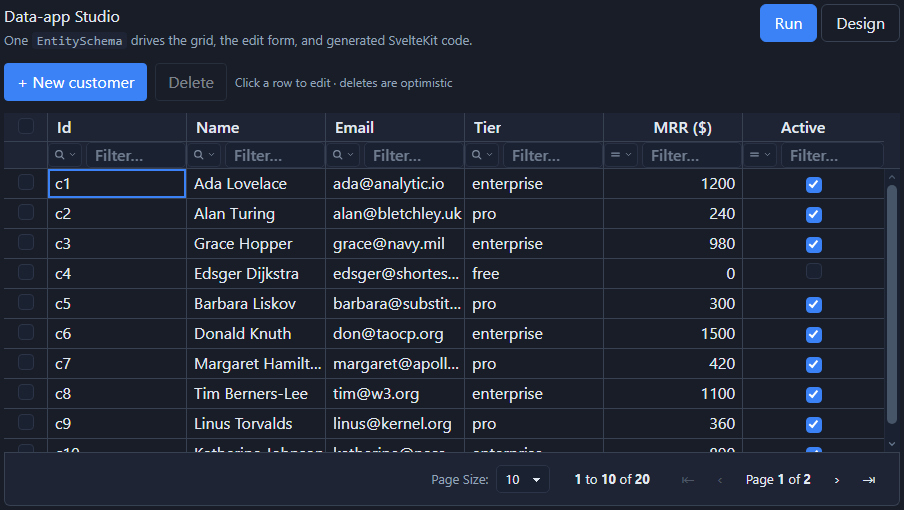
Studio connects directly to your relational database, reads a table's columns from the catalog, and scaffolds a connected CRUD screen. Supported: PostgreSQL, Supabase, MySQL / MariaDB, SQL Server, SQLite.
How it works
- You install the driver for your database (no driver is bundled).
npx @svgrid/studio add <table> --db <dialect> --url <conn>reads the table's columns - types, primary key,NOT NULL, and foreign keys - into anEntitySchema. FK columns becomerelationfields (Relations).- It generates three files; the API route is wired to that driver via
process.env.DATABASE_URL.
| Database | Install | --db |
Placeholders |
|---|---|---|---|
| PostgreSQL | pg |
postgres |
$1 + ILIKE |
| Supabase | pg |
supabase |
$1 + ILIKE |
| MySQL / MariaDB | mysql2 |
mysql |
? |
| SQL Server | mssql |
mssql |
@p1 |
| SQLite | better-sqlite3 |
sqlite |
? |
The generated +server.ts uses createSqlDataSource,
which turns the grid's sort / filter / page request into safe, parameterized
SQL (values are always bound; identifiers come from the schema-whitelisted plan).
PostgreSQL
npm i pg
export DATABASE_URL="postgres://user:pass@localhost:5432/app"
npx @svgrid/studio add customers --db postgres --url "$DATABASE_URL"
npm run dev
Connection string parts: postgres://USER:PASSWORD@HOST:PORT/DATABASE.
The generated code
src/routes/api/customers/+server.ts:
import pg from 'pg'
import { createKitHandlers, createSqlDataSource } from '@svgrid/enterprise'
import { customersSchema, type CustomersRow } from '$lib/customers.schema'

const pool = new pg.Pool({ connectionString: process.env.DATABASE_URL })
const source = createSqlDataSource<CustomersRow>({
  schema: customersSchema,
  table: 'customers',
  dialect: { placeholders: '$', ilike: true },
  execute: async (text, params) => (await pool.query(text, params)).rows,
})
export const { POST } = createKitHandlers({ schema: customersSchema, source })
Supabase
Step-by-step walkthrough: see the dedicated Supabase guide - create the table, set up Row-Level Security, and connect from the browser or a SvelteKit server route. It matches the live Supabase demo.
Supabase is Postgres, so use the same pg driver with your Supabase connection
string. In the Supabase dashboard: Project Settings -> Database -> Connection
string. For serverless / edge, use the connection pooler URL (port 6543).
npm i pg
export DATABASE_URL="postgres://postgres.[ref]:[password]@aws-0-[region].pooler.supabase.com:6543/postgres"
npx @svgrid/studio add customers --db supabase --url "$DATABASE_URL"
The generated route is identical to PostgreSQL above.
With the supabase-js client (RLS + auth)
Prefer the Supabase client so row-level security and auth are enforced per
user? Use createSupabaseDataSource from the browser - no server route at all.
The Supabase guide is the canonical walkthrough for that
path (keys, RLS policies, and the ready-made source); this page only covers the
connection-string route above.
MySQL / MariaDB
npm i mysql2
export DATABASE_URL="mysql://user:pass@localhost:3306/app"
npx @svgrid/studio add customers --db mysql --url "$DATABASE_URL"
Generated route:
import mysql from 'mysql2/promise'
import { createKitHandlers, createSqlDataSource } from '@svgrid/enterprise'
import { customersSchema, type CustomersRow } from '$lib/customers.schema'

const pool = mysql.createPool(process.env.DATABASE_URL ?? '')
const source = createSqlDataSource<CustomersRow>({
  schema: customersSchema,
  table: 'customers',
  execute: async (text, params) => {
    const [rows] = await pool.query(text, params)
    return rows as Record<string, unknown>[]
  },
})
export const { POST } = createKitHandlers({ schema: customersSchema, source })
SQL Server
npm i mssql
npx @svgrid/studio add customers --db mssql \
  --url "Server=localhost;Database=app;User Id=sa;Password=Your_Pass;Encrypt=true;TrustServerCertificate=true"
The generated route uses the mssql package with @p1 placeholders (bound as
p1, p2, ...) and reads its connection from process.env.DATABASE_URL.
SQLite
npm i better-sqlite3
npx @svgrid/studio add todos --db sqlite --url ./data.db
--url is the database file path. The generated route opens it with
better-sqlite3 (synchronous, no pool).
Turso (libSQL)
Turso is hosted SQLite (libSQL) over HTTP - it runs on
serverless and edge where a socket driver can't. The generated route uses the
@libsql/client and reads two env vars:
DATABASE_URL="libsql://<db>-<org>.turso.io"
DATABASE_AUTH_TOKEN="<your-db-token>"
import { createClient } from '@libsql/client'
const client = createClient({ url: env.DATABASE_URL ?? '', authToken: env.DATABASE_AUTH_TOKEN })
// createSqlDataSource execute:
execute: async (text, params) => (await client.execute({ sql: text, args: params })).rows,
Connect a database in the designer
Prefer clicking to typing CLI flags? The local designer (npx @svgrid/studio designer) has a Connect database wizard that does the same job visually:
- Pick a dialect (PostgreSQL / MySQL / SQL Server / SQLite / Supabase /
Turso) and enter the connection. A guided form collects host, port, database,
user, password, and SSL and assembles the string for you - or paste a full
connection string on the string tab. For MySQL that string is
mysql://user:pass@host:3306/db; passwords and every credential stay server-side and go only to.env. - Test connection proves it works and shows the real row count per table.
- Pick tables, and hit Preview on any of them to see actual rows before you import - a quick way to confirm you're pointed at the right database.
- Add entities reads the chosen tables' columns (types, primary key, foreign keys) into schemas and binds each to its SQL table.
Missing the driver? When a connect or preview fails because pg / mysql2 /
mssql / better-sqlite3 isn't installed, the wizard offers a one-click
install (it runs your project's package manager) and retries.
Already have entities? Open a SQL entity's Configure builder, paste a
connection string (the dialect is auto-detected), set the Schema (Postgres
search path, default public), and Preview data to load real rows onto the
canvas.
Online vs. local. Live connect / test / preview need the local designer, because a browser can't reach a raw SQL database and the driver is a server-side package. In the online designer you bind the entity (dialect + table + schema) and Generate app - the app connects for real at runtime via
DATABASE_URL. Want a live database inside the online designer? Use Supabase or the Local database.
One-click hosted database (from the designer)
Don't have a database yet? The designer's Get a database button provisions one
without leaving the flow: pick Neon (serverless Postgres), Supabase
(Postgres + auth), or Turso (edge SQLite). It opens the provider's one-click
"create a free database" page and binds every entity to the right dialect, so
Generate app emits a connected /api route per entity. Paste the connection
string into .env - the bundle ships a .env.example listing exactly which
vars each dialect needs (DATABASE_URL, plus DATABASE_AUTH_TOKEN for Turso).
Prefer zero setup? Bind to the Local database (PGlite) - a real, persistent Postgres in the browser with no account and no connection string, and switch to a hosted one later without touching the schema.
Postgres in the browser (PGlite)
You can even run real Postgres entirely in the browser with
PGlite - a WASM build of Postgres, under 3 MB. No server,
no connection string. Point createSqlDataSource's execute at PGlite's
query:
import { PGlite } from '@electric-sql/pglite'
import { createSqlDataSource } from '@svgrid/enterprise'

const db = new PGlite() // in-memory; use `new PGlite('idb://app')` to persist
await db.exec('CREATE TABLE customers (id serial primary key, name text, email text)')

const source = createSqlDataSource<Customer>({
  schema: customersSchema,
  table: 'customers',
  dialect: { placeholders: '$', ilike: true },
  execute: async (text, params) => (await db.query(text, params)).rows,
})
Every sort, filter, page, and edit runs actual parameterized SQL against the in-browser Postgres. Great for demos, offline / local-first apps, and tests.
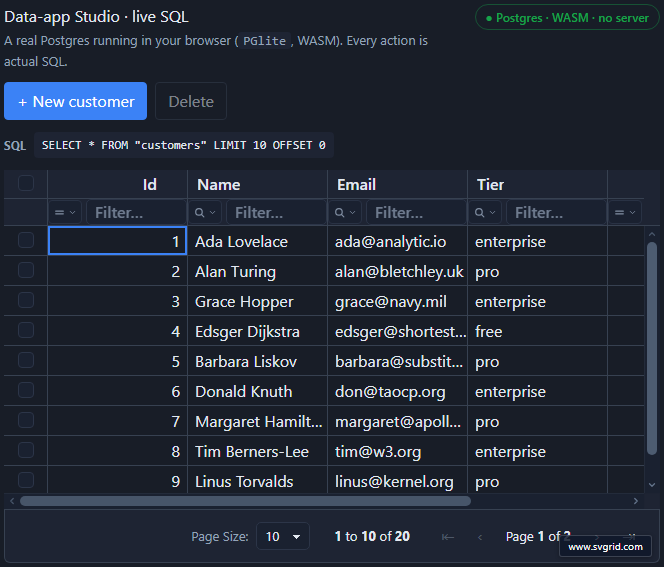
Live demo: Data-app Studio · live SQL - a full CRUD screen over PGlite; watch the SQL update as you sort and filter.
Scaffold every table at once
npx @svgrid/studio add --all --db postgres --url "$DATABASE_URL"
This lists the base tables and generates a screen (and route) for each.
Notes
- Schema drift: re-run
addafter a migration - only thesvgrid:managedregions regenerate, so your customizations survive. - Types: catalog types map to grid types automatically (int/numeric -> number, bool/bit -> boolean, timestamp -> datetime, date -> dateString, json -> json, else text). Refine anything in the schema file or the visual designer.
- Non-default schema: to read a table outside the default namespace (Postgres
public, SQL Serverdbo), passdbSchematocreateSqlDataSource- the table is then addressed as"schema"."table", each part quoted separately:
In the designer, set the SQL builder's Schema field and it emits this for you.createSqlDataSource({ schema: ordersSchema, table: 'orders', dbSchema: 'analytics', /* ... */ }) - Security: reads and writes are fully parameterized; the table name and columns come from the schema, never from request input.
Common gotchas
| Symptom | Cause and fix |
|---|---|
Cannot find module 'pg' (or mysql2 / mssql / better-sqlite3 / @libsql/client) |
No driver is bundled - install the one for your dialect (see the table above). |
Turso: The authenticated user is not authorized |
DATABASE_AUTH_TOKEN is missing or expired - mint a fresh DB token and set both it and the libsql:// DATABASE_URL in the server env. |
| Grid empty, server logs a connection error | DATABASE_URL is not set in the server environment (not client code, not PUBLIC_). Set it in your host's env. |
| Numbers arrive as strings | Postgres numeric comes back as text over some drivers. Use integer / bigint for numeric columns, or cast in a view. |
| Works locally, times out on Vercel / Netlify | Serverless functions exhaust direct connections. Use a pooler URL (Supabase port 6543, PgBouncer) and keep the pool small - see Deployment. |
SSL required / self-signed cert |
Add SSL to the pool (ssl: { rejectUnauthorized: false } for managed hosts) or the connection string's sslmode. |
| A column is missing from the grid | Re-run add after a migration - only the svgrid:managed regions regenerate, so new columns come in and your edits survive. |
See also
- Data binding - the underlying contract
- Drizzle schema · REST & custom APIs · In-memory
Live examples
- SvGrid Studio · Supabase - The Studio stack over hosted Postgres on Supabase, straight from the browser via supabase-js (PostgREST) and your project's public anon key. createSupabaseDataSource maps the grid's sort / filter / page / CRUD onto the query builder, introspectSupabaseTable adapts to any table AND detects foreign keys (a FK column auto-becomes a searchable lookup in the form), and createSupabaseRealtime makes it LIVE - change a row in the Supabase dashboard and it flashes in the grid (toggle the Live pill). Paste your URL + anon key, run the one-time setup SQL, done. RLS keeps the anon key safe.
- SvGrid Studio · live SQL - The Studio stack backed by a REAL Postgres running in the browser via PGlite (WASM), no server. createSqlDataSource turns the grid's sort / filter / page requests into parameterized SQL run through PGlite; the executed query is shown live under the toolbar. Full CRUD with optimistic updates against actual Postgres.