Master-Detail Rows - Expandable Detail Panels in SvGrid
How to wire expandable master-detail rows in SvGrid, from a nested grid of line items to lazy-fetched panels and programmatic expand on deep-link.
Most grids get asked to do this eventually: show a summary row, then let the user expand it to see the details underneath without navigating away, without a modal, without losing their scroll position. The usual workarounds - route to a detail page, cram everything into a tooltip, flatten nested data into extra columns - all have real costs in UX. Master-detail rows are the right tool.
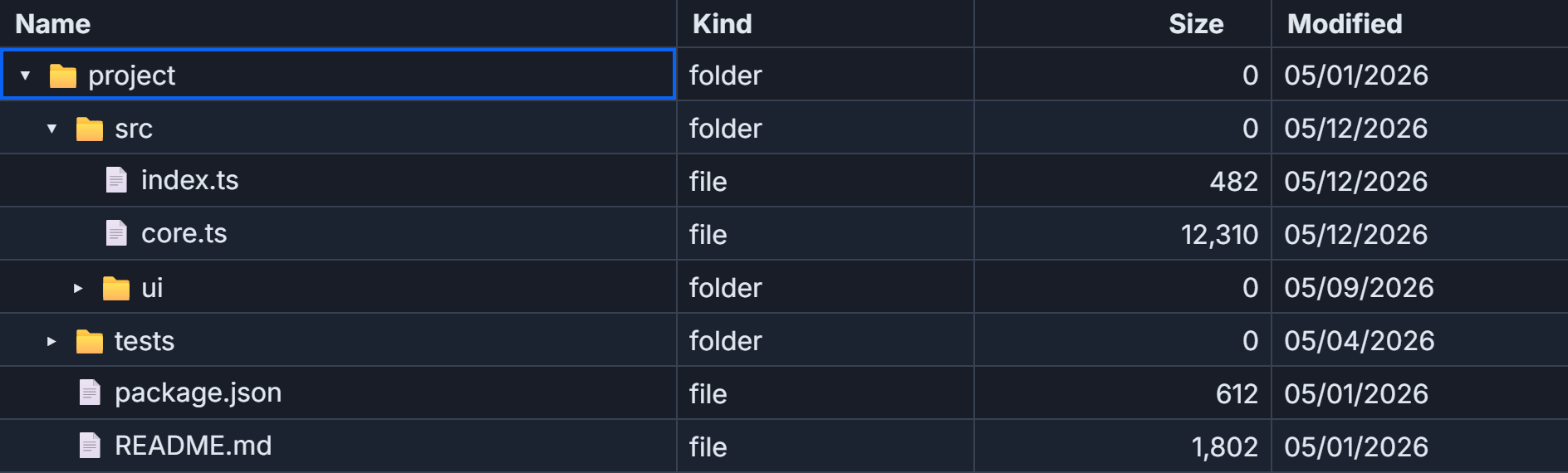
SvGrid ships rowExpandingFeature for exactly this. The expand toggle column is injected automatically, the detail slot is a plain Svelte snippet, and the feature works alongside sorting, filtering, and pagination without extra wiring.
What you're actually building
The scenario here is an order management table. Each Order carries a detail object with line items, a shipping status, and payment events. The master grid shows the summary: order ID, customer, status, total. When a row is expanded, a nested <SvGrid> renders the line items plus a small payment log - no extra network request because the data is embedded in the row.
Start with the types:
// types.ts
export type LineItem = {
  sku: string
  name: string
  qty: number
  price: number
}

export type OrderDetail = {
  lineItems: LineItem[]
  shippingStatus: 'pending' | 'picked' | 'shipped' | 'delivered'
  payments: { event: string; at: string; amount: number }[]
}

export type Order = {
  id: string
  customer: string
  email: string
  status: 'pending' | 'paid' | 'fulfilled' | 'returned'
  placedAt: string
  total: number
  items: number
  detail: OrderDetail
}
Wiring the master grid and detail snippet
The full working component below. Three things to notice before reading it:
rowExpandingFeatureis the only addition totableFeatures- sorting and filtering compose with it without conflict.- The
detailRowprop takesrenderSnippet(detailPanel), not the snippet directly. SkippingrenderSnippetcauses the panel to silently never render. - The inner
<SvGrid>is a completely independent instance with its own columns and its own scroll context. It does not inherit anything from the outer grid.
<script lang="ts">
import {
SvGrid,
tableFeatures,
rowExpandingFeature,
rowSortingFeature,
columnFilteringFeature,
renderSnippet,
type ColumnDef,
type SvGridApi,
} from '@svgrid/grid'
import type { Order, LineItem } from './types'
const orders: Order[] = [
{
id: 'ORD-23001',
customer: 'Ava Thompson',
email: '[email protected]',
status: 'paid',
placedAt: '2026-06-08 09:14',
total: 248.94,
items: 3,
detail: {
shippingStatus: 'picked',
lineItems: [
{ sku: 'NB-A5-DEEP', name: 'Hardcover notebook (A5)', qty: 2, price: 18.50 },
{ sku: 'PEN-CHISEL-2PK', name: 'Calligraphy pens (2-pack)', qty: 1, price: 8.99 },
{ sku: 'TOTE-NAVY-L', name: 'Canvas tote (large)', qty: 1, price: 32.00 },
],
payments: [{ event: 'Captured (Visa ****4242)', at: '06-08 09:14', amount: 248.94 }],
},
},
{
id: 'ORD-23002',
customer: 'Liam Park',
email: '[email protected]',
status: 'fulfilled',
placedAt: '2026-06-07 17:31',
total: 91.50,
items: 2,
detail: {
shippingStatus: 'delivered',
lineItems: [
{ sku: 'DESK-MAT-XL', name: 'Desk mat (XL, charcoal)', qty: 1, price: 54.00 },
{ sku: 'HUB-USB4-7P', name: 'USB-4 hub (7-port)', qty: 1, price: 37.50 },
],
payments: [{ event: 'Captured (MC ****9981)', at: '06-07 17:31', amount: 91.50 }],
},
},
{
id: 'ORD-23003',
customer: 'Sofia Reyes',
email: '[email protected]',
status: 'pending',
placedAt: '2026-06-09 11:02',
total: 420.00,
items: 4,
detail: {
shippingStatus: 'pending',
lineItems: [
{ sku: 'CHAIR-ERGO-BLK', name: 'Ergonomic chair (black)', qty: 1, price: 320.00 },
{ sku: 'LUMBAR-PAD', name: 'Lumbar support pad', qty: 2, price: 25.00 },
{ sku: 'ARMREST-GEL', name: 'Gel armrest covers', qty: 2, price: 25.00 },
],
payments: [],
},
},
]
const features = tableFeatures({
rowExpandingFeature,
rowSortingFeature,
columnFilteringFeature,
})
const columns: ColumnDef<Order>[] = [
{ accessorKey: 'id', header: 'Order', size: 110 },
{ accessorKey: 'customer', header: 'Customer', size: 180 },
{ accessorKey: 'status', header: 'Status', size: 110 },
{ accessorKey: 'placedAt', header: 'Placed', size: 150 },
{ accessorKey: 'items', header: 'Items', size: 70, meta: { align: 'right' } },
{
accessorKey: 'total',
header: 'Total',
size: 100,
meta: { align: 'right' },
cell: (ctx) => `$${ctx.getValue<number>().toFixed(2)}`,
},
]
const lineItemColumns: ColumnDef<LineItem>[] = [
{ accessorKey: 'sku', header: 'SKU', size: 140 },
{ accessorKey: 'name', header: 'Product', size: 260 },
{ accessorKey: 'qty', header: 'Qty', size: 60, meta: { align: 'right' } },
{
accessorKey: 'price',
header: 'Unit price',
size: 100,
meta: { align: 'right' },
cell: (ctx) => `$${ctx.getValue<number>().toFixed(2)}`,
},
{
id: 'subtotal',
header: 'Subtotal',
size: 100,
meta: { align: 'right' },
cell: (ctx) => {
const r = ctx.row.original
return `$${(r.qty * r.price).toFixed(2)}`
},
},
]
let api = $state<SvGridApi | null>(null)
</script>
{#snippet detailPanel({ row }: { row: { original: Order } })}
<div class="detail-wrap">
<p class="detail-meta">
{row.original.id} - shipping: <strong>{row.original.detail.shippingStatus}</strong>
</p>
<SvGrid
data={row.original.detail.lineItems}
columns={lineItemColumns}
style="height: 180px"
/>
{#if row.original.detail.payments.length > 0}
<ul class="payment-log">
{#each row.original.detail.payments as p}
<li>{p.event} · {p.at} · ${p.amount.toFixed(2)}</li>
{/each}
</ul>
{:else}
<p class="no-payments">No payment events yet.</p>
{/if}
</div>
{/snippet}
<SvGrid
{features}
data={orders}
{columns}
detailRow={renderSnippet(detailPanel)}
getRowId={(row) => row.id}
style="height: 420px"
onApiReady={(a) => { api = a }}
/>
<style>
.detail-wrap { padding: 12px 16px; background: var(--sg-bg, #f7f7f9); }
.detail-meta { margin: 0 0 8px; font-size: 0.85rem; color: #555; }
.payment-log { margin: 8px 0 0; padding-left: 18px; font-size: 0.82rem; }
.no-payments { margin: 8px 0 0; font-size: 0.82rem; color: #999; }
</style>
Notice the getRowId prop on the outer grid. Without it, the feature falls back to array index as the row identifier. That's fine until the user sorts - indices shift, previously expanded rows appear collapsed. (row) => row.id costs nothing and prevents that class of bug entirely.
The lazy-fetch variant
When detail data is not bundled with the row - say, a customer grid where order history lives behind an endpoint - replace the embedded reference with a reactive fetch inside the snippet. The expand/collapse behavior is identical; only the data source changes.
{#snippet detailPanel({ row }: { row: { original: Customer } })}
  {#await fetchOrders(row.original.id)}
    <p class="loading">Loading orders...</p>
  {:then orders}
    <div class="detail-wrap">
      <SvGrid
        data={orders}
        columns={orderColumns}
        style="height: 220px"
      />
    </div>
  {:catch err}
    <p class="error">Failed to load: {err.message}</p>
  {/await}
{/snippet}
One practical issue: fetchOrders fires every time the row is expanded, including re-expansions. For a grid where users open and close the same rows frequently, cache results in a Map<string, Order[]> keyed by customer ID outside the component. The first expansion fetches; subsequent ones return instantly from the map.
Expanding rows programmatically
api.setRowExpanded(rowId, true) lets you drive expand state from outside the grid. Two common uses:
Deep-linking. A URL like /orders?expand=ORD-23001 should open that row automatically. Read the parameter in onApiReady:
<SvGrid
  {features}
  data={orders}
  {columns}
  detailRow={renderSnippet(detailPanel)}
  getRowId={(row) => row.id}
  style="height: 420px"
  onApiReady={(a) => {
    api = a
    const target = new URL(location.href).searchParams.get('expand')
    if (target) a.setRowExpanded(target, true)
  }}
/>
Toolbar buttons. "Expand all" can be built with api.getDisplayedRows() and a loop - though for large datasets you probably want to expand only the first page, not 5,000 rows at once.
Things that will bite you if you skip them
The toggle column added by rowExpandingFeature is pinned to the left and excluded from the column virtualizer's tracking range. It does not count against threshold calculations and does not shift column indices. That part just works.
What does not work without explicit care:
Height on the inner grid. The detail panel has no intrinsic height from the feature's perspective. If you omit
style="height: ..."on the nested<SvGrid>, it collapses to zero. Set an explicit pixel height, or use a CSSmin-heightrule on.detail-wrapif the row count varies.Expand state after a data swap. Replacing the
dataprop with a new array reference (common after a full server refresh) resets all expand state. If you need to preserve it, capture the list of open row IDs before the refresh, then replayapi.setRowExpanded(id, true)for each one inonApiReadyof the refreshed grid - or stash the whole view state withapi.getState()and restore it withapi.setState(saved).Two-level nesting. The inner
<SvGrid>is a fully independent instance and can itself receiverowExpandingFeatureand adetailRowprop. Two levels is the practical limit; three levels pushes users into horizontal scrolling on any viewport narrower than a wide monitor.
Master-detail rows are one of those features that feel like a lot of machinery until you actually wire them up. The expanding itself is four lines - add the feature, write the snippet, pass detailRow, call renderSnippet. Everything else in this post is about the edge cases that surface once real data and real users get involved.
Related reading
- Displaying Tree Data and Hierarchies in SvGrid
- Building an Order Management Dashboard in Svelte
- Lazy-Loading Master-Detail Content in SvGrid
- Row Drag-and-Drop Reordering in a Svelte Data Grid
- Conditional Row Styling in SvGrid
Tagged: Master-detail