Server editing
The Server-Side Row Model has a read side (getRows) and an optional write
side. Implement whichever of createRow / updateRow / deleteRow your
backend supports, and createServerDataSource gives you matching controller
methods that call through and keep the on-screen page in sync. This page is a
deep dive into that write path: the non-optimistic default, built-in optimistic
updates with rollback, the saving state, surfacing validation errors, and
optimistic concurrency.
It builds on the Server-Side Row Model, where the same controller owns paging, sorting, and filtering.
The optional write side
ServerDataSource is a read model by default. The three write methods are
optional; add only the ones your backend can serve:
type ServerDataSource<Row> = {
  getRows(request): Promise<{ rows: ReadonlyArray<Row>; rowCount: number }>

  // Optional write side - implement whichever your backend supports.
  createRow?(input: Partial<Row>): Promise<Row>
  updateRow?(id: string, patch: Partial<Row>): Promise<Row>
  deleteRow?(id: string): Promise<void>
}
A source that only implements getRows stays a pure read model. If you call a
controller method whose source counterpart is missing, it rejects with a clear
error (the datasource does not implement updateRow()) rather than failing
silently - so a read-only source stays read-only.
The controller methods
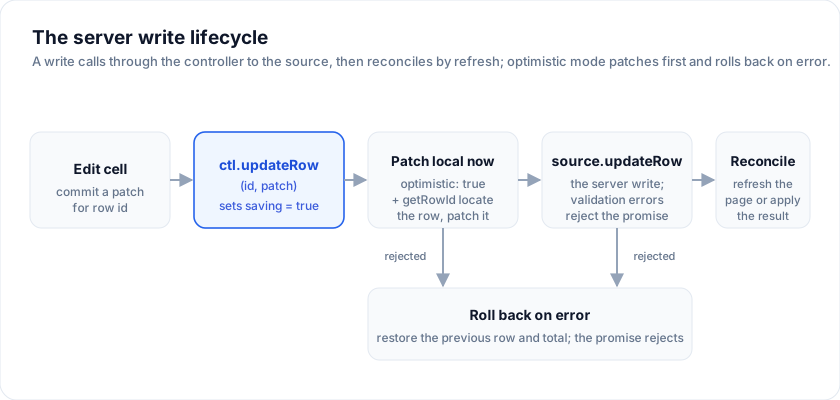
Each write method flips saving, runs the source write, and then reconciles the
current page:
| Method | Does |
|---|---|
createRow(input) |
Create through the source, then refresh() the page. Resolves with the created row. |
updateRow(id, patch) |
Update by id. Non-optimistic by default; optimistic when configured. |
deleteRow(id) |
Delete by id. Non-optimistic by default; optimistic when configured. |
const source: ServerDataSource<Row> = {
  async getRows(req) {
    const res = await fetch('/api/rows', { method: 'POST', body: JSON.stringify(req) })
    const { rows, total } = await res.json()
    return { rows, rowCount: total }
  },
  async updateRow(id, patch) {
    const res = await fetch(`/api/rows/${id}`, { method: 'PATCH', body: JSON.stringify(patch) })
    if (!res.ok) throw new Error(await res.text())
    return res.json() // the saved row
  },
  async createRow(input) {
    const res = await fetch('/api/rows', { method: 'POST', body: JSON.stringify(input) })
    if (!res.ok) throw new Error(await res.text())
    return res.json()
  },
  async deleteRow(id) {
    const res = await fetch(`/api/rows/${id}`, { method: 'DELETE' })
    if (!res.ok) throw new Error(await res.text())
  },
}

const ctl = createServerDataSource(source, { pageSize: 50, onChange: (s) => (view = s) })

// Commit a cell edit:
await ctl.updateRow(String(row.id), { status: 'active' })
Non-optimistic by default
By default writes are non-optimistic: the controller runs the source method,
and only after the follow-up refresh() of the current page lands does the grid
reflect the change. The sequence for updateRow:
savinggoestrue.source.updateRow(id, patch)runs on the server.- On success, the current page is re-fetched (
refresh()), picking up the authoritative row. savinggoesfalse.
This is the safest default - what you render is always what the last fetch returned - at the cost of a round trip before the change is visible. If the write itself fails, the read state is left untouched.
Built-in optimistic updates
For instant feedback, opt in with optimistic: true and a getRowId so the
controller can locate a row inside the current page:
const ctl = createServerDataSource(source, {
  pageSize: 50,
  onChange: (s) => (view = s),
  optimistic: true,
  getRowId: (r) => String(r.id), // required - without it, optimistic is ignored
})
Now updateRow patches the local row immediately, then reconciles with the
server result:
updateRow(id, patch)mergespatchinto the local row on the spot, awaitssource.updateRow, and replaces the local row with the returned server row. If the server rejects, it restores the previous row and re-throws.deleteRow(id)removes the local row and decrementstotalat once. If the server rejects, it restores both the row and the count.
If the target row is not on the current page, optimistic updateRow /
deleteRow fall back to the plain non-optimistic path (there is nothing local
to patch). createRow is always non-optimistic - a new row's server-assigned
id and page position are not known until the refresh.
The saving state
Every write flips a dedicated saving flag on the state, separate from the
loading flag used by getRows:
type ServerState<Row> = {
  rows: ReadonlyArray<Row>
  total: number
  loading: boolean   // a getRows fetch is in flight
  saving: boolean    // a create / update / delete is in flight
  error: unknown
  // ...pageIndex, pageSize, pageCount, sortModel, filterModel
}
Bind saving to a toolbar spinner or to disable the save button, and loading
to the grid overlay - they never fight each other.
<button disabled={view.saving} onclick={save}>
  {view.saving ? 'Saving...' : 'Save'}
</button>
Surfacing validation errors
Server-side validation is just a rejected promise. Have your source throw when
the server responds with a validation failure; the controller lets that
rejection propagate out of createRow / updateRow / deleteRow (and, in
optimistic mode, rolls the local change back first). Catch it at the call site
and show it:
<script lang="ts">
  let formError = $state<string | null>(null)

  async function save(id: string, patch: Partial<Row>) {
    formError = null
    try {
      await ctl.updateRow(id, patch)
    } catch (err) {
      // Optimistic mode has already rolled the row back to its prior value.
      formError = err instanceof Error ? err.message : 'Save failed'
    }
  }
</script>

{#if formError}
  <div role="alert">{formError}</div>
{/if}
Because the write methods reject rather than throwing into onChange, your
render never sees a half-applied state: either the write resolved and the page
reconciled, or it rejected and (in optimistic mode) rolled back.
Optimistic concurrency
Optimistic UI (patch-then-reconcile) is separate from optimistic
concurrency (rejecting stale writes). The controller handles the UI; you
enforce concurrency on the server by carrying a version token - a version
counter or an updatedAt timestamp - and rejecting a write whose token no
longer matches the current row.
async updateRow(id, patch) {
  const res = await fetch(`/api/rows/${id}`, {
    method: 'PATCH',
    headers: { 'If-Match': String(patch.version) }, // the version the client last read
    body: JSON.stringify(patch),
  })
  if (res.status === 409) throw new Error('This row changed since you opened it - reload and retry.')
  if (!res.ok) throw new Error(await res.text())
  return res.json() // includes the new version
}
On the server, make the write conditional so a stale token updates nothing:
UPDATE rows SET status = $status, version = version + 1
WHERE id = $id AND version = $expectedVersion;   -- 0 rows affected => conflict, return 409
A 409 becomes a rejected promise, so in optimistic mode the local row rolls
back automatically and your catch shows the conflict. Return the fresh row
(with its new version) from a successful write so the next edit carries the
current token.
See also
- Server-Side Row Model - the datasource contract, request lifecycle, and race safety.
- Server filtering - the read side: filter model, operators, and parameterized WHERE.