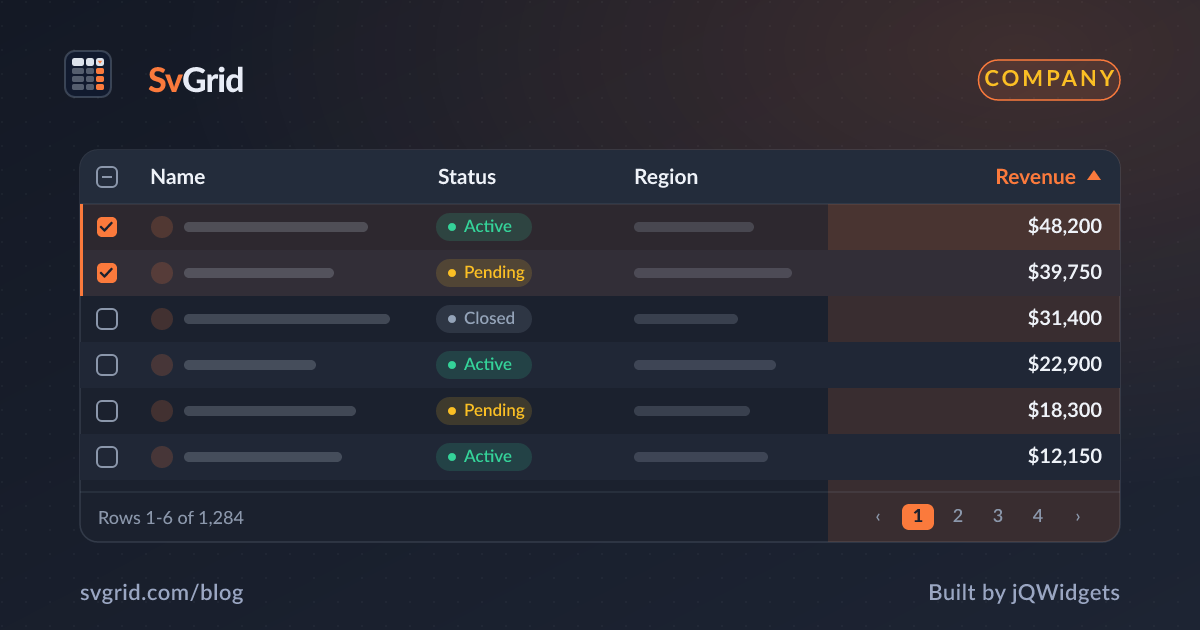
Introducing SvGrid - A Native Svelte 5 Data Grid from jQWidgets
Why we built a brand-new data grid for Svelte 5 from scratch, what makes it different, and how the headless core plus render component fit together.
Today we are introducing SvGrid, a data grid built from the ground up for Svelte 5. It is not a port, not a wrapper around an older grid, and not a thin adapter over a framework-agnostic engine. It is a native Svelte 5 component, written on runes, by the team at jQWidgets.
 Named, saved views in SvGrid.
Why a new grid, and why now
We have shipped UI components since 2011, first jQWidgets, then the Smart UI web components on htmlelements.com. Over those years our components have gone into products at thousands of companies, including Samsung, Boeing, NVIDIA, Microsoft, Nokia, and Intel.
Svelte 5 changed the calculus. Runes - $state, $derived, $effect - give the framework fine-grained reactivity that a data grid can exploit directly. A grid is, at its core, a reactivity problem: a hundred thousand cells, any of which can change, and you want to repaint only what actually moved. Building on runes natively, rather than wrapping an engine designed for another model, lets the grid be both smaller and faster.
So we did not adapt an existing product. We wrote a new one.
Headless core plus a render component
SvGrid ships in two layers, and you can use either:
createSvGridis the headless engine: the row-model pipeline for filtering, sorting, grouping, pagination, and expansion, with no markup. You own every DOM node.<SvGrid>is the render component built on that engine: an accessible, virtualized, themeable grid you configure with plain props.
Most teams start with <SvGrid> and drop to the core only for a screen that needs a bespoke layout, reusing their column definitions untouched. The headless foundation is the reason you never hit a wall.
<script lang="ts">
  import { SvGrid, type ColumnDef } from '@svgrid/grid'

  const columns: ColumnDef<{}, Person>[] = [
    { field: 'firstName', header: 'First name' },
    { field: 'age',       header: 'Age' },
  ]
</script>

<SvGrid data={rows} columns={columns} />
What it does out of the box
- Row and column virtualization, 100,000 rows by 100 columns stay smooth.
- Sorting, Excel-style filtering, grouping with aggregation, tree and master-detail rows.
- Inline editing with typed editors and validation.
- Server-side data, full keyboard navigation, and WAI-ARIA accessibility by default.
- A theming system built entirely on
--sg-*CSS custom properties.
Free core, optional Enterprise
@svgrid/grid is MIT-licensed and free for commercial use, no license key, no row cap. The optional @svgrid/enterprise pack adds data export (Excel, PDF, CSV, HTML), import, printing, pivot tables, and an AI assistant for teams that need them.
AI-native from day one
SvGrid ships an MCP (Model Context Protocol) server and an llms.txt file, so assistants like Claude and Cursor can ground their answers in the real API instead of guessing. If you build with an AI pair-programmer, the grid was designed to meet you there.
Where to start
- Render your first grid in under 5 minutes
- Browse the 150+ live demos or read the documentation.
We have been building data grids for over a decade. SvGrid is the one we are most excited about, because for the first time, the framework underneath is as fine-grained as the grid wants to be.