# Computed fields with formulas
A formula field works out its value from the other fields of the same
record: a stock value from quantity and unit cost, a status from a reorder
level, a date 90 days after the last count. Nobody types into it, and views,
footers, charts and automations read it like any other field.
> Live demo: Inventory - https://svgrid.com/demos/515-base-inventory/
> SvGrid Base is part of the **Suite edition** of `@svgrid/enterprise`. Without a key it runs with a watermark.
This page builds a small inventory: Items with a quantity, a unit cost and a
reorder level, then a Suppliers table they link to. In the demo above,
change an item's Qty or Unit cost and Stock value and the footer total
follow.
## 1. Start with the stored fields
Formulas need something to read. Declare the Items table with the fields
people type in:
```svelte
```
`summary` turns on the footer row; `columnAdder` and `fieldMenu` let people
add and edit fields, which step 8 uses.
## 2. Add a formula field
Add one column to the list:
```ts
const stockValue = {
field: 'value',
header: 'Stock value',
fieldType: 'formula',
fieldProps: { formula: '{Qty} * {Unit cost}', result: 'currency', precision: 2, summary: 'sum' },
}
```
A field reference is a name in braces. It matches a field's header or its
`field` key, ignoring case and the spaces around it, so `{Qty}`, `{qty}` and
`{ QTY }` all read `qty`, and `{unitCost}` reads the same field as
`{Unit cost}`.
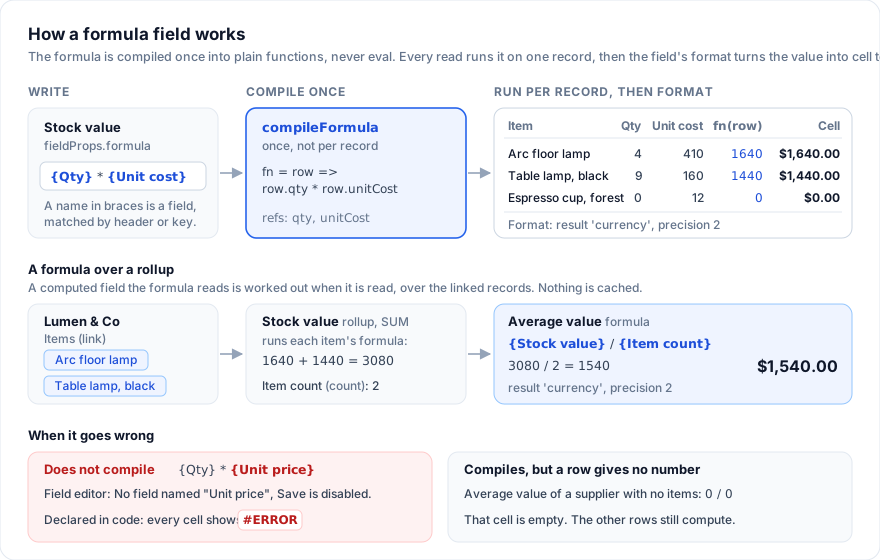
The formula is compiled once into a function. Each time a cell, a sort or a
footer needs the value, that function runs on the record, and `result` and
`precision` decide how the number is shown:
What you see:
- Arc floor lamp shows `$1,640.00`, the espresso cups `$0.00`. The column is
right-aligned because the result is a currency.
- The footer shows the sum of the column, `$4,704.00`, formatted like the
cells.
- The cells are read-only. Edit Qty and the stock value changes as you
commit the edit.
- A form view leaves the field out: there is nothing to type.
- The value is never stored in the record. A base kept in a database does
not write it either (see [What is not written](https://svgrid.com/docs/help/base/data/#what-is-not-written)).
[Format the result](#format-the-result) has the details of `result`,
`precision` and `summary`.
## 3. Branch with IF
A status that says whether to reorder, and how many to order:
```ts
const status = {
field: 'status',
header: 'Status',
fieldType: 'formula',
fieldProps: { formula: 'IF({Qty} = 0, "Out", IF({Qty} <= {Reorder level}, "Low", "OK"))' },
}
const toOrder = {
field: 'toOrder',
header: 'To order',
fieldType: 'formula',
fieldProps: { formula: 'IF({Qty} <= {Reorder level}, {Reorder level} * 2 - {Qty}, 0)', result: 'number', precision: 0 },
}
```
Status reads Low for the lamp (4 is at or under 5), OK for the table lamp and
the mugs, Out for the espresso cups and Low for the speaker (2 is at its level
of 2). To order shows 6, 0, 0, 24 and 2.
`IF(condition, then, else)` works out only the branch it takes, so
`IF({Qty} = 0, 0, 1000 / {Qty})` never divides by zero. Without the third
argument the field is empty when the condition is false. `SWITCH` is lazy
the same way: only the result it returns is worked out.
A comparison on its own is a value too: `{Qty} <= {Reorder level}` shows
`true` or `false` in the cell.
## 4. Join text
`&` joins values into text:
```text
{Item} & " (" & {Qty} & " in stock)"
```
gives `Arc floor lamp (4 in stock)`. `CONCATENATE({Item}, " x", {Qty})` does
the same with a function: `Arc floor lamp x4`.
Numbers join as plain numbers, without the format of the field they came
from. `"$" & {Unit cost} * 1.15` gives `$471.49999999999994`; round first,
and it gives `$471.5`:
```text
"$" & ROUND({Unit cost} * 1.15, 2)
```
`*` comes before `&`, so the multiplication needs no parentheses. An empty
field joins as nothing: an Arc floor lamp with no Qty shows
`Arc floor lamp ( in stock)`.
## 5. Work with dates
When each item is due for its next count, and how long since the last one:
```ts
const nextCount = {
field: 'nextCount',
header: 'Next count',
fieldType: 'formula',
fieldProps: { formula: 'DATEADD({Last counted}, 90, "days")', result: 'date', dateFormat: 'friendly' },
}
const sinceCount = {
field: 'sinceCount',
header: 'Days since count',
fieldType: 'formula',
fieldProps: { formula: 'DATETIME_DIFF(TODAY(), {Last counted}, "days")', result: 'number', precision: 0 },
}
```
Next count shows `December 4, 2026` for the lamp: `DATEADD` returns a date,
and a date shows in the field's `dateFormat`. Days since count is 39 on
October 14, 2026.
A date field stores a day as text, `2026-09-05`. A formula reads it as that
day at local midnight, the same way the cell shows it and the way `TODAY()`
is, so `DAY`, `WEEKDAY` and `DATETIME_DIFF` give the same answer in every
time zone.
Other text is a date only when it has a four-digit year and a separator:
`"October 5, 2026"` and `"10/05/2026"` are dates, `"1"` and `"12"` are not,
so `YEAR("1")` is empty.
To put a date into text, turn it into `YYYY-MM-DD` with `DATESTR` first.
Joined as it is, a date becomes a UTC timestamp such as
`2026-12-03T22:00:00.000Z`:
```text
"Count by " & DATESTR(DATEADD({Last counted}, 90, "days"))
```
gives `Count by 2026-12-04`.
`DATETIME_DIFF(a, b, unit)` is `a` minus `b`, cut to whole units, in
seconds when there is no unit. `DATEADD(d, n, unit)` adds `n` units, days
when there is no unit. Both take the same units:
| Unit | Also written |
|---|---|
| `milliseconds` | `millisecond`, `ms` |
| `seconds` | `second`, `s` |
| `minutes` | `minute`, `m` |
| `hours` | `hour`, `h` |
| `days` | `day`, `d` |
| `weeks` | `week`, `w` |
| `months` | `month` |
| `years` | `year`, `y` |
Case does not matter, so `"M"` is minutes too. Days, weeks, months and years
count calendar days, so a daylight-saving change in between does not cut a
day short. Adding months keeps the day inside the month: January 31 plus one
month is February 28. A unit written in the formula that is not in the table
is an error the editor shows; one read from a field gives an empty cell.
To test a date, compare it with another date:
```text
IF(DATEADD({Last counted}, 90, "days") < TODAY(), "Count now", "")
```
When one side is a date value (from `TODAY()`, `DATEADD` and the like), the
other side is read as a date too, so `{Last counted} < TODAY()` works.
`IS_BEFORE(a, b)` and `IS_AFTER(a, b)` read both sides as dates whatever
they are, and are false when either side is empty.
## 6. Read another table
Add a Suppliers table and link each item to one. A formula cannot follow a
link by itself; a lookup brings the linked field into the record, and the
formula reads the lookup.
```ts
const suppliers = [
{ id: 's1', name: 'Lumen & Co', leadDays: 10, items: ['1', '2'] },
{ id: 's2', name: 'Kiln Ceramics', leadDays: 21, items: ['3', '4'] },
{ id: 's3', name: 'Signal Audio', leadDays: 7, items: ['5'] },
]
// Items: each row gets supplier: ['s1'] and so on, plus these columns.
const itemLinks = [
{ field: 'supplier', header: 'Supplier', fieldType: 'link', fieldProps: { table: 'suppliers', multiple: false, inverse: 'items' } },
{ field: 'supplierName', header: 'Supplier name', fieldType: 'lookup', fieldProps: { linkField: 'supplier', field: 'name' } },
{ field: 'leadTime', header: 'Lead time', fieldType: 'lookup', fieldProps: { linkField: 'supplier', field: 'leadDays' } },
{
field: 'reorderNote',
header: 'Reorder note',
fieldType: 'formula',
fieldProps: { formula: 'IF({Qty} <= {Reorder level}, "Order " & ({Reorder level} * 2 - {Qty}) & " from " & {Supplier name}, "")' },
},
{
field: 'arrives',
header: 'Arrives by',
fieldType: 'formula',
fieldProps: { formula: 'DATEADD(TODAY(), {Lead time}, "days")', result: 'date', dateFormat: 'friendly' },
},
]
const supplierTable = {
id: 'suppliers',
name: 'Suppliers',
primaryField: 'name',
data: suppliers,
columns: [
{ field: 'name', header: 'Supplier', fieldType: 'text' },
{ field: 'leadDays', header: 'Lead time (days)', fieldType: 'number', fieldProps: { format: 'integer' } },
{ field: 'items', header: 'Items', fieldType: 'link', fieldProps: { table: 'items', multiple: true, inverse: 'supplier' } },
{ field: 'itemCount', header: 'Item count', fieldType: 'count', fieldProps: { linkField: 'items' } },
{ field: 'stockValue', header: 'Stock value', fieldType: 'rollup', fieldProps: { linkField: 'items', field: 'value', aggregation: 'SUM' } },
{ field: 'avgValue', header: 'Average value', fieldType: 'formula', fieldProps: { formula: '{Stock value} / {Item count}', result: 'currency', precision: 2 } },
],
}
```
Reorder note reads `Order 6 from Lumen & Co` for the lamp. A lookup is a
list, one value per linked record: joined into text it reads as the values
separated by commas, and in arithmetic it adds them up, so `{Lead time}` is
10 for the lamp. With no supplier the list is empty, which joins as nothing
and counts as 0.
It works the other way too. The Suppliers rollup sums Stock value, a
formula in Items, and shows `$3,080.00` for Lumen & Co in the formula's
format. Average value is a formula over that rollup and the count:
`$1,540.00`. A supplier with no items divides by zero and shows an empty
cell.
Read the link field itself and you get record ids: `{Supplier}` is `s1`, not
the name. Use a lookup of the linked table's primary field for the name.
[Tables and links](https://svgrid.com/docs/help/fields/#tables-and-links) has the rest of the link,
lookup and rollup setup.
## 7. Use the computed values
A formula field sorts, filters, groups and colors rows by what it computes,
and its footer summary reads the same values:
```ts
import type { FieldView } from '@svgrid/enterprise/base'
const views: FieldView[] = [
{ id: 'stock', name: 'Stock', type: 'grid', state: { grouping: ['status'], sorting: [{ id: 'value', desc: true }] } },
{
id: 'reorder',
name: 'Reorder',
type: 'grid',
color: {
mode: 'conditions',
rules: [
{ color: '#f82b60', condition: { column: 'status', kind: 'text', op: 'is', value: 'Out' } },
{ color: '#fcb400', condition: { column: 'status', kind: 'text', op: 'is', value: 'Low' } },
],
},
state: {
advancedFilter: {
kind: 'fieldFilter',
conjunction: 'or',
conditions: [
{ column: 'status', kind: 'text', op: 'is', value: 'Low' },
{ column: 'status', kind: 'text', op: 'is', value: 'Out' },
],
},
},
},
{ id: 'value', name: 'Value by supplier', type: 'chart', chart: { kind: 'bar', x: 'supplier', y: 'value' } },
]
```
Stock groups the items by Status, highest value first in each group.
Reorder shows the three items that need ordering and colors the espresso
cups red, the other two yellow. The chart adds up Stock value per supplier.
In the charts, a formula can be the value added up only when its `result`
is `number`, `currency` or `percent`. Any formula can be the field a chart
groups by, and it groups by the computed value: a chart of Status has the
bars Low, OK and Out. A date result groups by month, as a date field does.
A lookup can group a chart too, one group per linked value.
In the view bar's filter, a formula field follows its `result`. `number`,
`currency` and `percent` get `=`, `<`, `>=` and the other number operators;
`date` gets is before, is within and the other date operators. With
`result: 'auto'` the column's `cellDataType` decides (`'number'` or
`'date'`), and without one the field gets the text operators (contains,
does not contain, is, is not, is empty, is not empty). A condition written
in code names its kind itself:
`{ column: 'value', kind: 'number', op: 'gte', value: 1000 }`.
Automations see computed values as well. A condition on a formula fires
when the formula's result starts to match, and `{Field name}` in a message
is the formatted value. A token matches a header or a `field` key the way a
formula does, ignoring case and outer spaces, so `{reorder note}` works too:
```ts
import type { BaseAutomation } from '@svgrid/enterprise/base'
const lowStock: BaseAutomation = {
id: 'low-stock',
name: 'Low stock',
enabled: true,
trigger: { type: 'recordMatches' },
condition: { kind: 'fieldFilter', conjunction: 'and', conditions: [{ column: 'status', kind: 'text', op: 'is', value: 'Low' }] },
actions: [{ type: 'notify', message: '{Item}: {Reorder note}', severity: 'warning' }],
}
```
The [OKR template](https://svgrid.com/docs/help/base/templates/#okrs) does this with a number: its
"Target reached" automation runs when Progress, a formula, reaches 1.
## 8. Write a formula in the field editor
People who use the base can add formulas without code. Press "+" after the
last column (or Edit field in a column's menu), name the field and pick
Formula under "Computed and automatic". The editor shows:
- **Formula**: a text box. As you type, a message under it says what is
wrong (`No field named "Unit price"`, `Unknown function SUMM`) and the box
is marked invalid.
- A button for each other field. A click puts `{Field name}` where the cursor
is.
- **Functions**: shows the name of every function the formula can call
(Hide functions closes the list).
- **Format the result as**: As computed, Number, Currency, Percent or Date,
then Precision for a number, currency or percent, Currency symbol for a
currency, and Date format for a date.
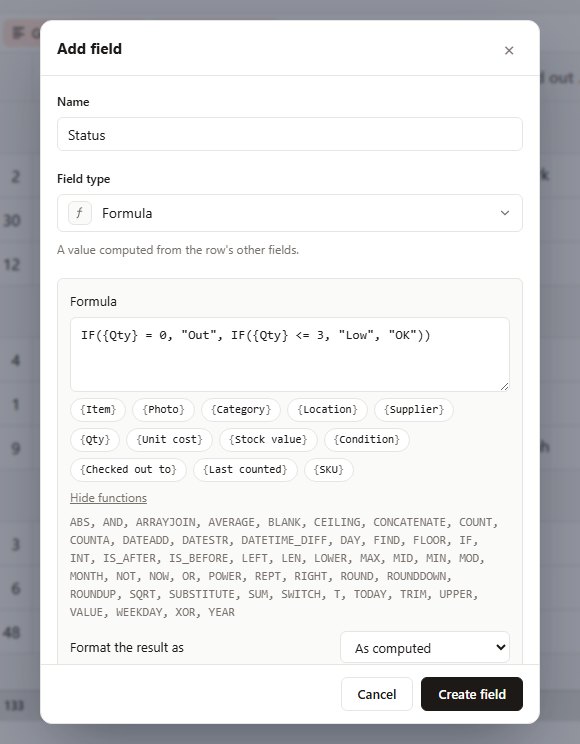
While the message shows, Save (Create field for a new field) is disabled,
and its tooltip repeats the message. A formula left empty can be saved: its
cells stay empty until someone writes it.
A formula cannot read its own field. The editor will not save
`{Stock value} + 1` as the formula of Stock value, and the same formula
declared in code shows `#ERROR` in every cell.
The formula is kept as `fieldProps.formula`; `onColumnAdd` and
`onColumnChange` hand back the column list with it, ready to store (see
[Create and edit fields](https://svgrid.com/docs/help/fields/#create-and-edit-fields)).
## The formula language
| Part | Written as | Notes |
|---|---|---|
| Field | `{Unit cost}` | A header or `field` key, any case |
| Number | `12`, `0.5`, `.5` | No thousands separators |
| Text | `"Low"` or `'Low'` | `\` before a character keeps it: `"say \"hi\""` |
| True and false | `TRUE`, `FALSE` | Any case |
| Function | `ROUND({Qty} * 1.1, 0)` | Any case: `round(...)` works |
| Grouping | `( ... )` | |
Operators, from the first applied to the last:
| Operators | Does |
|---|---|
| `-` before a value | Negates it |
| `*` `/` | Multiply, divide. Dividing by zero gives an empty value |
| `+` `-` | Add, subtract |
| `&` | Joins as text |
| `=` `!=` `<>` `<` `>` `<=` `>=` | Compare; `<>` is the same as `!=` |
There is no `^` (use `POWER`), no `%` (use `MOD`) and no `==`.
How values turn into each other:
- **In arithmetic**, an empty field is 0, `TRUE` is 1, text that is a number
(`"12"`) is that number, and other text gives no number, so the cell is
empty. A lookup's list adds up.
- **In a comparison**, when either side is a date value both sides compare
as dates: a stored `"2026-09-05"` is read as that day, and an empty or
unreadable side matches nothing (only `!=` is true). When either side is a
number, both compare as numbers: `{Qty} = "4"` is true. Otherwise they
compare as text, exactly: `"a" = "A"` is false, and `"10" < "9"` is true.
- **In IF, AND, OR and NOT**, empty, `FALSE` and 0 are false. Everything
else is true, including the text `"0"` and `"false"`.
## Functions
The editor's Functions list has the same names as `FORMULA_FUNCTIONS`.
Examples use the lamp: Item `Arc floor lamp`, Qty 4, Unit cost 410, Reorder
level 5, Last counted `2026-09-05`, Status `Low`.
**Logic**
| Function | Does | Example |
|---|---|---|
| `IF(cond, then, else)` | `then` when `cond` is true, else `else` (or empty) | `IF({Qty} > 3, "many", "few")` is `many` |
| `AND(a, b, ...)` | True when every argument is true | `AND({Qty} > 0, {Qty} <= 5)` is true |
| `OR(a, b, ...)` | True when any argument is true | `OR({Qty} = 0, {Qty} > 3)` is true |
| `NOT(a)` | The opposite | `NOT({Qty} > 3)` is false |
| `XOR(a, b, ...)` | True when an odd number of arguments are true | `XOR(TRUE, FALSE, TRUE)` is false |
| `BLANK()` | An empty value | `IF({Qty} > 0, {Qty}, BLANK())` |
| `SWITCH(v, m1, r1, ..., default)` | The result after the first match of `v`, compared as text; else the default or empty. Only that result is worked out | `SWITCH({Status}, "Out", "Order now", "Low", "Order soon", "")` is `Order soon` |
**Text**
| Function | Does | Example |
|---|---|---|
| `CONCATENATE(a, b, ...)` | Joins the arguments | `CONCATENATE({Item}, " x", {Qty})` is `Arc floor lamp x4` |
| `LEN(t)` | Number of characters | `LEN({Item})` is 14 |
| `UPPER(t)`, `LOWER(t)` | Changes case | `UPPER(LEFT({Item}, 3))` is `ARC` |
| `TRIM(t)` | Drops spaces at both ends | `TRIM(" bolt ")` is `bolt` |
| `LEFT(t, n)` | First `n` characters (default 1) | `LEFT({Item}, 3)` is `Arc` |
| `RIGHT(t, n)` | Last `n` characters (default 1) | `RIGHT({Item}, 4)` is `lamp` |
| `MID(t, start, n)` | `n` characters from position `start` (1 is the first); without `n`, the rest | `MID({Item}, 5, 5)` is `floor`, `MID({Item}, 5)` is `floor lamp` |
| `FIND(part, t, start)` | Position of `part` in `t`, 0 when missing; case matters | `FIND("lamp", {Item})` is 11 |
| `SUBSTITUTE(t, old, new)` | Replaces every `old` | `SUBSTITUTE({Item}, " ", "-")` is `Arc-floor-lamp` |
| `REPT(t, n)` | `t` repeated `n` times, at most 1000 | `REPT("*", {Qty})` is `****` |
| `T(v)` | `v` when it is text, else empty text | `T({Qty})` is empty |
| `VALUE(t)` | The number in a text, ignoring other characters; empty when there is no digit | `VALUE("$1,200.50")` is 1200.5, `VALUE("n/a")` is empty |
| `ARRAYJOIN(list, sep)` | A lookup's values joined by `sep` (default `, `), empty ones left out | `ARRAYJOIN({Supplier name}, " / ")` |
**Numbers**
| Function | Does | Example |
|---|---|---|
| `SUM(a, b, ...)` | Adds; lists add up too | `SUM({Qty}, 2, 3)` is 9 |
| `AVERAGE(a, b, ...)` | Mean of the values that are not empty | `AVERAGE(2, 4, "")` is 3 |
| `MAX(...)`, `MIN(...)` | Largest, smallest; empty values ignored | `MAX(0, MIN(1, 1.4))` is 1 |
| `COUNT(...)` | How many arguments are numbers | `COUNT(1, "2", 3)` is 2 |
| `COUNTA(...)` | How many are not empty | `COUNTA(1, "", "x")` is 2 |
| `ROUND(x, digits)` | Rounds; negative digits round to tens, hundreds | `ROUND(1234.5, -2)` is 1200 |
| `ROUNDUP(x, digits)` | Rounds up | `ROUNDUP(2.41, 1)` is 2.5 |
| `ROUNDDOWN(x, digits)` | Rounds down | `ROUNDDOWN(2.49, 1)` is 2.4 |
| `INT(x)` | Rounds down to a whole number | `INT(-2.5)` is -3 |
| `ABS(x)` | Drops the sign | `ABS(-3)` is 3 |
| `MOD(x, d)` | Remainder, with the sign of `x` | `MOD(7, 3)` is 1, `MOD(-7, 3)` is -1 |
| `POWER(x, p)` | `x` to the power `p` | `POWER(2, 10)` is 1024 |
| `SQRT(x)` | Square root; empty for a negative | `SQRT(16)` is 4 |
| `CEILING(x, s)`, `FLOOR(x, s)` | Up or down to a multiple of `s` (default 1) | `CEILING(2.1)` is 3, `CEILING(7, 5)` is 10, `FLOOR(2.37, 0.05)` is 2.35 |
**Dates**
| Function | Does | Example |
|---|---|---|
| `TODAY()` | Today at midnight, local time | `DATEADD(TODAY(), 7, "days")` |
| `NOW()` | This moment | `NOW() > TODAY()` is true |
| `YEAR(d)`, `MONTH(d)`, `DAY(d)` | Parts of a date; months count from 1 | `MONTH({Last counted})` is 9 |
| `WEEKDAY(d)` | Day of the week, 0 for Sunday | `WEEKDAY({Last counted})` is 6 |
| `DATEADD(d, n, unit)` | `d` plus `n` units (default days); units in [step 5](#5-work-with-dates) | `DATEADD({Last counted}, 2, "weeks")` is September 19, `DATEADD({Last counted}, 1, "months")` is October 5 |
| `DATETIME_DIFF(a, b, unit)` | `a` minus `b` in whole units (default seconds) | `DATETIME_DIFF("2026-10-14", {Last counted}, "days")` is 39, with `"months"` it is 1 |
| `IS_BEFORE(a, b)`, `IS_AFTER(a, b)` | Compare two dates; false when either is empty | `IS_BEFORE({Last counted}, "2026-10-01")` is true |
| `DATESTR(d)` | The date as `YYYY-MM-DD` text | `DATESTR(DATEADD({Last counted}, 90, "days"))` is `2026-12-04` |
## Format the result
The formula computes a number, text, `true`/`false`, a date or a list.
`fieldProps.result` says how the cell shows a number, and a date written as
text:
| `result` | Shows | Other properties |
|---|---|---|
| `auto` (default, "As computed") | A number as is, rounded to 10 decimals: `1640` | |
| `number` | 1640 as `1,640.0` | `precision` |
| `currency` | 1640 as `$1,640.00` | `precision`, `symbol` (default `$`) |
| `percent` | 0.4 as `40%` | `precision` |
| `date` | Text written as a stored date (`2026-12-04` or `2026-12-04T10:30:00Z`) as a date; other text as it is | `dateFormat`: `local`, `friendly`, `us`, `european`, `iso` |
Whatever `result` says, a date value (from `TODAY()`, `DATEADD`) shows as a
date in `dateFormat` (`local` without one), `true` and `false` show as those
words, and a list shows its values joined by commas. Text shows as it is.
Under `date`, only text in the stored-date form turns into a date, so
`IF({Qty} = 0, "Count now", DATEADD({Last counted}, 90, "days"))` shows
`Count now` or the date, and `"1"` stays `1`. A number with
`result: 'date'` stays a number.
Set `precision` (0 to 8) for a number, currency or percent. Without it the
cell uses the number field's defaults: 1 decimal place for a number, 2 for a
currency and 0 for a percent.
`result` also decides the footer. With `number`, `currency` or `percent` the
footer offers Sum, Average, Median, Min, Max and Range; with `date` it
offers Earliest date, Latest date and Date range (days); with `auto` only
Empty, Filled, Unique, Percent empty and Percent filled. Set `result` on any
formula you want to add up, and keep the choice in `fieldProps.summary`, as
in step 2 ([Summaries at the bottom](https://svgrid.com/docs/help/fields/#summaries-at-the-bottom)).
## When a formula is wrong
There are two kinds of problem, and they show differently:
- **The formula does not compile.** The field editor shows the message and
will not save: `No field named "Nope"`, `Unknown function FOO`,
`Unknown unit "fortnights" in DATEADD: ...`, `Expected ")" at the end`,
`The formula ends too early`, `Unclosed "{" at 1`, `Unclosed text at 1`,
`Unexpected "^" at 7`, `A formula cannot read its own field {Stock value}`.
Positions count characters from 1. A formula declared in code with a
mistake, or one that stops compiling because a field it reads was deleted,
shows `#ERROR` in every cell. Delete field in a column's menu asks first
when formulas read the field, and names them: "These formulas read it and
will show #ERROR: Stock value, Status."
- **It compiles, but a row gives no number.** Division by zero, `"abc" * 2`,
`SQRT(-1)`: that cell is empty, and the other rows still compute.
## Rename a field a formula reads
Rename "Unit cost" to "Cost" in the field editor and every other formula in
the table that reads `{Unit cost}` now reads `{Cost}`. Stock value keeps
working, and `onColumnChange` hands back the column list with the rewritten
formulas, ready to store. Text inside quotes is left alone: `"{Unit cost}"`
stays as it is.
A reference to the `field` key needs no rewrite, because renaming changes
the header only: `{qty} * {unitCost}` keeps working whatever people call
the columns. When a header is also the key, as with "Qty" and `qty`, both
spellings follow the new name, and both still read the field.
Only a rename made in the field editor rewrites formulas. Change a header
in the columns you pass the grid and `{Unit cost}` names no field any more:
the formula shows `#ERROR` until you change it too.
## Turn a formula into a stored field
Change a formula field's type in the field editor, to Number or Single line
text for example, and each record stores the value the formula computed,
converted to the new type. Stock value to Number stores `1640` for the
lamp; to Single line text it stores `"1640"`, not the formatted
`$1,640.00`; a date result becomes `YYYY-MM-DD`. Before you save, the
editor says "Every value converts." or how many cells will be cleared or
cut short. The
values arrive in `onColumnChange` as `data`. A formula that did not
compile stores nothing. Lookups, rollups and counts convert the same way.
## Formulas from code
The same parser is exported, for checking a formula in your own UI or
computing a value outside the grid.
| Export | What it is |
|---|---|
| `compileFormula(src, resolve)` | Returns `{ fn, refs }`, or throws `FormulaError` (an empty formula throws too) |
| `formulaError(src, resolve)` | The message, or `null` when the formula compiles |
| `FormulaError` | The error class, with the message the editor shows |
| `FORMULA_FUNCTIONS` | Every function name, sorted |
`resolve` turns a name from the braces into the row key it reads, or `null`
for no such field. `fn(row)` never throws: a problem gives `null`. `refs`
lists the keys the formula reads.
```ts
import { compileFormula, formulaError } from '@svgrid/enterprise/base'
const columns = [
{ field: 'qty', header: 'Qty' },
{ field: 'unitCost', header: 'Unit cost' },
]
const resolve = (name: string) => {
const n = name.trim().toLowerCase()
const hit = columns.find((c) => c.header.toLowerCase() === n || c.field.toLowerCase() === n)
return hit ? hit.field : null
}
formulaError('{Qty} * {Unit cost}', resolve) // null
formulaError('{Qty} * {Unit price}', resolve) // 'No field named "Unit price"'
const { fn, refs } = compileFormula('{Qty} * {Unit cost}', resolve)
fn({ qty: 4, unitCost: 410 }) // 1640
refs // ['qty', 'unitCost']
```
A formula box of your own, with the same message under it as the field
editor:
```svelte
{#if message}{message}
{/if}
{FORMULA_FUNCTIONS.join(', ')}
```
On the server, where formula values are not stored, compute them with the
same formula. A SvelteKit endpoint that totals the stock:
```ts
// src/routes/api/stock-value/+server.ts
import { json } from '@sveltejs/kit'
import { compileFormula, FormulaError } from '@svgrid/enterprise/base'
import { loadItems } from '$lib/server/items'
const keys: Record = { qty: 'qty', 'unit cost': 'unitCost' }
const resolve = (name: string) => keys[name.trim().toLowerCase()] ?? null
export async function GET() {
try {
const { fn } = compileFormula('{Qty} * {Unit cost}', resolve)
const items: Array> = await loadItems()
const total = items.reduce((sum, row) => sum + Number(fn(row) ?? 0), 0)
return json({ total })
} catch (e) {
if (e instanceof FormulaError) return json({ error: e.message }, { status: 400 })
throw e
}
}
```
For the text the cell shows, format included, fill the column the way the
grid does. `fillFieldColumn` gives back the column with its `fieldFn` and
`formatter`:
```ts
import { enableBase, fillFieldColumn } from '@svgrid/enterprise/base'
enableBase()
const columns = [
{ field: 'qty', header: 'Qty', fieldType: 'number' },
{ field: 'unitCost', header: 'Unit cost', fieldType: 'number' },
]
const value = { field: 'value', header: 'Stock value', fieldType: 'formula', fieldProps: { formula: '{Qty} * {Unit cost}', result: 'currency', precision: 2 } }
const filled = fillFieldColumn(value, columns)
const compute = filled.fieldFn as (row: Record) => unknown
const show = filled.formatter as (c: { value: unknown }) => string
show({ value: compute({ qty: 4, unitCost: 410 }) }) // "$1,640.00" in an English locale
```
## How it runs
A formula is parsed once, when its column is filled (on load and after any
change to the fields), into plain functions. Nothing is passed to `eval` or
`Function`, so a formula a user types cannot run code.
Each read runs those functions against the record, and nothing is cached
between reads. A formula that reads another formula, a lookup, a rollup or
a count works that field out at the same moment, over the linked records
where it has to. A chain that loops back on itself stops after a few steps
and reads the stored record (empty) instead of hanging.
## Pitfalls
- **A date field holds a day, not a moment.** It reads as local midnight, so
`{Last counted} = TODAY()` can be true but `{Last counted} = NOW()` never
is.
- **Two dates as text compare as text.** A stored date against another
stored date, or against a date written in quotes
(`{Last counted} < "2026-10-01"`), compares as text. That orders
`YYYY-MM-DD` correctly, but an empty date is "before" every date. Use
`IS_BEFORE` and `IS_AFTER`, or compare with a date value such as
`TODAY()`, when empty dates should match nothing.
- **A date joined with `&` is a UTC timestamp.** Wrap it in `DATESTR`.
- **An empty number is 0.** `{Qty} = 0` is true for an item with no Qty, so
step 3 calls it Out.
- **Text comparisons are exact.** `=` and `SWITCH` care about case and
spaces: `"low"` does not match `"Low"`.
- **`"m"` is minutes.** So is `"M"`. Write `"months"` for months.
## Next
- [Linked records](https://svgrid.com/docs/help/base/linked-records/): links, lookups and rollups between
tables, which formulas read.
- [Views](https://svgrid.com/docs/help/base/views/): filters, sorts, groups and charts over computed
fields.
- [Automations](https://svgrid.com/docs/help/base/automations/): conditions and messages that use formula
results.
- [Your own field type](https://svgrid.com/docs/help/base/custom-field-type/): a computed type of your own
when a formula is not enough.
- [Field types](https://svgrid.com/docs/help/fields/#declare-columns-by-type): every type and its
`fieldProps`.
---
SvGrid is the Svelte 5 data grid (`npm install @svgrid/grid`, MIT). This page: https://svgrid.com/docs/help/base/formulas/ . All docs: https://svgrid.com/llms.txt